Robotic mower with or without a wire: STIHL iMOW and STIGA
Wire or RTK satellite navigation? How a robot determines the edge of the lawn, when a STIHL iMOW with a perimeter wire is the right fit, when a wire-free STIGA robot is, and what to ask before you buy.
Robotic mower with or without a wire: STIHL iMOW and STIGA
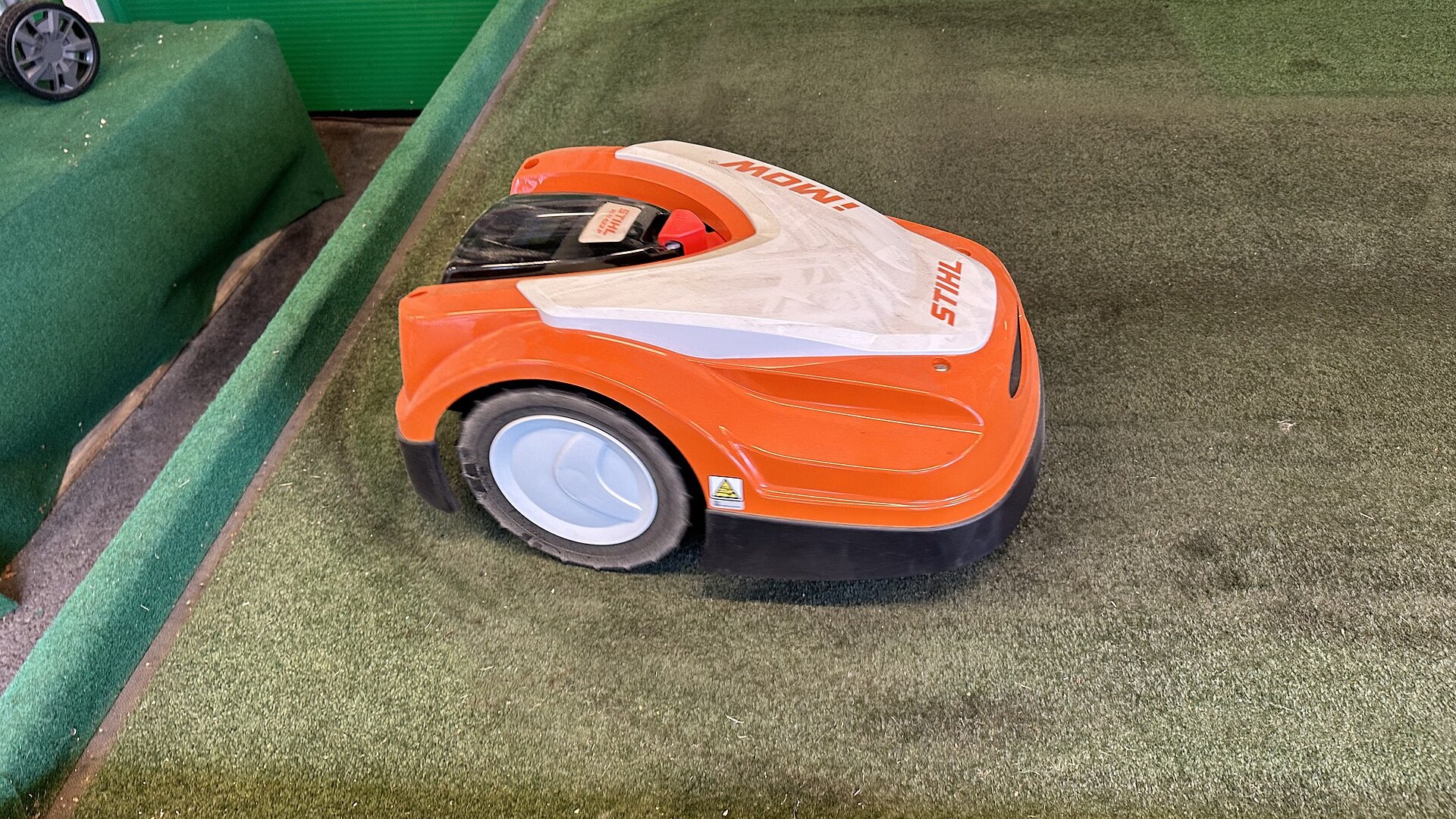
A robotic mower with a perimeter wire (for example a STIHL iMOW) and a wire-free robotic mower with RTK satellite navigation (for example a STIGA) mow in the same way: often, short and with mulching. The difference is how the robot knows where the edge of the lawn is. A wire in the ground works under trees and next to the house, and it needs neither satellites nor a mobile network to define the boundary. A wire-free robot is set up in an app, and when the garden changes you simply edit the map, but it needs a clear view of the sky and, with STIGA models, also a permanent mobile connection.
In Senica, customers are asking us more and more often about wire-free robots. Below is a factual comparison of the two approaches, so that you can tell which one suits your plot. We sell and service both STIHL iMOW and STIGA robotic mowers. The information in this article is based on the manufacturers’ materials, as of October 2026. If you already know you want a robot with a wire, you’ll find a practical overview in the article STIHL iMOW robotic mower: when it’s a yes and when it’s a no.
What you’ll learn in this article
- how a robotic mower determines the edge of the lawn: wire, RTK satellite navigation, camera
- how the STIHL iMOW works and how wire-free STIGA robots work
- what gets in the way of a wire-free robot: trees, buildings, a weak mobile signal
- a comparison table and when to choose which type
- questions to ask before you buy, and frequently asked questions
Three ways a robot knows where to mow
Perimeter wire
A thin perimeter wire (also called a boundary wire) is laid around the lawn. It is either buried just below the surface or pegged to the ground. The charging station sends a weak signal through it, and the robot changes direction when it reaches the wire. Flower beds, a pond or a tree that the robot should go around are marked off with the wire in the same way.
- Advantages: proven technology, works under tree canopies, next to walls and in narrow passages, needs no internet to define the boundary and comes with no fees.
- Disadvantages: installation takes time, the wire can be cut during work in the garden, and it has to be relaid when the flower beds change.
RTK satellite navigation (wire-free)
The robot has a receiver for satellite systems (GPS, Galileo and others, collectively known as GNSS). A position determined from satellites alone can be out by several metres, so the robot receives RTK correction data (real-time refinement of its position) from a reference station. This station can stand right in the garden, or the corrections come from the manufacturer over the mobile network. The result is accuracy to within centimetres, and the edge of the lawn exists only as a virtual map in the app.
- Advantages: no digging and no wire, changing the garden simply means editing the map, and the robot usually mows in regular stripes.
- Disadvantages: it needs a good view of the sky. Dense tree canopies, high walls, buildings and metal fences weaken the signal, and the robot may stop in such places.
Camera and other sensors
A camera, ultrasonic sensors or LiDAR (a laser sensor) help to recognise the edge of the lawn and obstacles. In most cases, they complement the wire or the satellites. For example, STIGA robots with the ‘v’ designation have a camera which, according to the manufacturer, tells the lawn apart from other surfaces and helps the robot avoid obstacles, people and animals. Navigation and the boundary, however, still rely on RTK. There are also robots that find their way using only a camera or a LiDAR sensor, with neither a wire nor satellites. A camera does, however, need enough light.
STIHL iMOW: a robot with a perimeter wire
All current STIHL iMOW models work with a perimeter wire. During installation, a perimeter wire and at least one guide wire are laid, and the robot relies on them to find its way at all times. Within the marked-off area, it mows along randomly chosen paths. As of October 2026, STIHL does not offer a wire-free robotic mower.
Good to know:
- The wire works just as well in the shade of trees, next to the house and in a broken-up lawn, because the robot needs neither a satellite nor a mobile signal to define the boundary.
- Current iMOW models are set up in the MY iMOW app, but the mowing schedule is stored in the robot itself.
- iMOW EVO models have a mobile connection and a position receiver (GPS). It is not used for navigation but to show the robot’s position in the app and to protect it against theft (outside the set home area, the robot locks itself).
- STIHL recommends leaving the installation of the wire and the set-up of the robot to a dealer.
You’ll find details on the shape of the area, slopes and obstacles for the iMOW in the article STIHL iMOW robotic mower: when it’s a yes and when it’s a no. In Senica, we’ll recommend a suitable model based on your plot.
STIGA: a wire-free robot with RTK navigation
Current STIGA robotic mowers (the A series models, including the newer Vista models with a camera) work without a perimeter wire. According to the manufacturer, they combine RTK satellite navigation with the AGS system, which remembers where and when the signal in the garden is weaker and plans the mowing accordingly.
How it is set up:
- you record the edge of the lawn in the STIGA.GO app by guiding the robot around the edge (you control it from your phone and walk alongside it)
- in the app, you set up zones, the passages between them and the places the robot must not go
- the robot then drives along the whole boundary by itself and checks it
What a STIGA robot needs:
- a permanent mobile connection. The manufacturer states that the robot does not work without a stable connection to STIGA Cloud. If the connection drops out while it is mowing, the robot finishes its current route and returns to the station.
- an RTK correction signal at the installation site. If it is not available from the manufacturer’s network, you need to set up your own reference station in the garden (an accessory).
- open sky above the charging station. The station should not stand under a tree or under a shelter, and the only protection the manufacturer allows is the original STIGA cover.
- distance from tall obstacles. The manual specifies at least 40 cm from walls, fences and hedges higher than 50 cm.
STIGA robots have GPS position tracking and, depending on the model, a theft alert as well.
Data connection and fees: the connection is included in the price for a period that depends on the model. For the current Vista models, STIGA states 10 years, and for some other models a shorter period. After that, an annual fee is charged. We’ll check the exact terms for the specific model for you in the shop before you buy.
Comparison: with or without a wire
| Criterion | With a perimeter wire (e.g. STIHL iMOW) | Wire-free, RTK (e.g. STIGA) |
|---|---|---|
| Installation | laying the perimeter wire and the guide wire | recording the boundary in the app, no digging |
| Changing the garden | the wire has to be relaid | editing the map is enough |
| Trees, buildings, walls | the wire defines the boundary, no signal from the sky needed | can reduce the accuracy of the satellite signal, problem spots may have to be excluded |
| Mobile signal and internet | not needed to define the boundary | a permanent connection is essential |
| Running costs for navigation | none | an annual data fee after the free period (up to 10 years, depending on the model) |
| Mowing pattern | random paths within the marked-off area | planned stripes following the map |
| Typical reason for stopping | a broken wire | a weak satellite signal or a dropped connection |
| Suitable garden | broken-up, with trees, next to the house | open, with a clear view of the sky |
When to choose a robot with a wire
- the lawn is under trees, next to a tall house or between walls
- you have narrow passages between parts of the garden
- the mobile signal in the garden is weak
- you don’t want to pay for a data connection and want the robot to mow to schedule even without the internet
- the garden rarely changes, so the wire only needs to be laid once
When to choose a wire-free robot
- the lawn is open, with clear sky above most of the area
- you don’t want to dig or deal with a broken wire
- you often change the garden (new flower beds, a pool, a patio)
- you have a stable mobile signal and the RTK correction signal is available where you live
If part of the lawn is open and part is under trees, the less favourable part is decisive. A wire-free robot may keep stopping there, and spots with a weak signal may have to be excluded from mowing.
What to ask before buying a wire-free robot
- Is the RTK correction signal available in my area, or will I need my own reference station? (STIGA lets you check this on stiga.com or in the app.)
- How strong is the mobile signal where the charging station will be and at the edges of the lawn?
- How many years of data are included in the price, and what does an extension cost?
- Which parts of the garden are under trees or right next to a building, and what will the robot do if it loses the signal there?
- Who will install the robot, and who will service it?
Frequently asked questions (FAQ)
Does the STIHL iMOW have GPS?
iMOW EVO models have a GPS receiver, which is used to show the position in the app and to protect against theft, not for navigation. On all iMOW models, the mowing boundary is defined by the perimeter wire.
Does a wire-free robot work under trees?
To a limited extent. STIGA states in its manual that the satellite signal can be weakened by trees with dense foliage, hedges, walls, metal fences, buildings and reflective surfaces, as well as by thick fog, heavy rain or snowfall. If the signal is disrupted, it recommends excluding that part from mowing. According to the manufacturer, the AGS system plans the mowing according to the signal quality at a given place and time.
Does a STIGA robot need the internet?
Yes. According to the manufacturer, the robot needs a permanent mobile connection to STIGA Cloud, through which it receives the correction data. Without it, the robot won’t start mowing.
Is a wire-free robot more precise?
With a good signal, it mows in regular stripes with centimetre accuracy. With a weak signal, on the other hand, a wire is more reliable, as it doesn’t depend on the sky or on the mobile network.
Can a broken wire be repaired?
Yes. The break is located and the wire is joined with a waterproof connector. For STIHL iMOW robots, we can advise you as part of our servicing.
Which type can handle a steeper slope?
That depends on the specific model, not on the type of navigation. STIHL states 40% for the iMOW and 45% for EVO models, and with an approved traction wheel kit, 50 to 55% for EVO models, depending on the model. STIGA states 45 to 50% for its robots, depending on the model, but the passages between zones may have a gradient of no more than 20%. With both brands, special rules apply to where the boundary is placed when there is a slope at the edge of the lawn. Check the limits in the manual for the specific model.
Let us help you at Zakservices in Senica
If you can’t decide between a robot with a wire and a wire-free one, bring a sketch or photos of your plot. We’ll look at the trees, buildings, passages and slope and recommend whether a robot with a wire or a wire-free one suits you. At Zakservices (Zakservices, s.r.o.) we sell and service STIHL iMOW and STIGA robotic mowers and other garden machinery from STIHL, SUPA TECHNIKA, STIGA, WOLF-Garten, Cub Cadet and DAKR.
Visit us: Obchodná 493/2A, 905 01 Senica (white building opposite the Kaufland car park).
Phone: 0904 446 915, 034/651 7072
Email: zakservices@zakservices.sk
Website: https://www.zakservices.sk
We always confirm the model, availability and current prices directly in the shop.